

By December 30, 2026, the EU Deforestation-Free Supply Chain Regulation (EUDR) will fundamentally redefine the availability of industrial biomass, favoring producers with total supply chain transparency. Professional buyers understand that securing wholesale ENplus A1 wood pellets Europe requires more than just a purchase order; it demands a partnership with a vertically integrated producer capable of navigating geopolitical shifts and rising feedstock costs. You recognize that supply chain volatility and inconsistent ash content are no longer acceptable risks for large-scale heating operations.
This guide provides the technical framework to master these procurement complexities, ensuring your infrastructure benefits from a mechanical durability of at least 98% and 100% regulatory compliance. We'll show you how to secure long-term supply stability through direct-from-producer sourcing. Our analysis examines the logistical infrastructure of the Baltic production hub, the specific 2026 certification requirements for ENplus A1 standards, and the strategies for managing multi-modal transport to eliminate industrial bottlenecks. By applying these data-driven procurement strategies, you can minimize maintenance costs and ensure operational reliability across your entire facility network.
Key Takeaways
- Analyze the impact of 2026 EUDR regulations on biomass supply chains and the operational transition toward carbon-neutral heating.
- Identify technical benchmarks for premium pellets, specifically the requirement for ash content below 0.7% to minimize industrial boiler maintenance costs.
- Evaluate the logistical efficiency of multi-modal distribution systems that utilize rail, bulk vessels, and truck transport for consistent delivery.
- Master the strategic procurement of wholesale ENplus A1 wood pellets Europe by prioritizing direct-from-producer contracts to ensure long-term volume security.
- Audit supplier reliability through mandatory certifications including ENplus A1, SBP, and FSC to guarantee 100% regulatory compliance.
Navigating the European Wholesale Wood Pellet Market in 2026
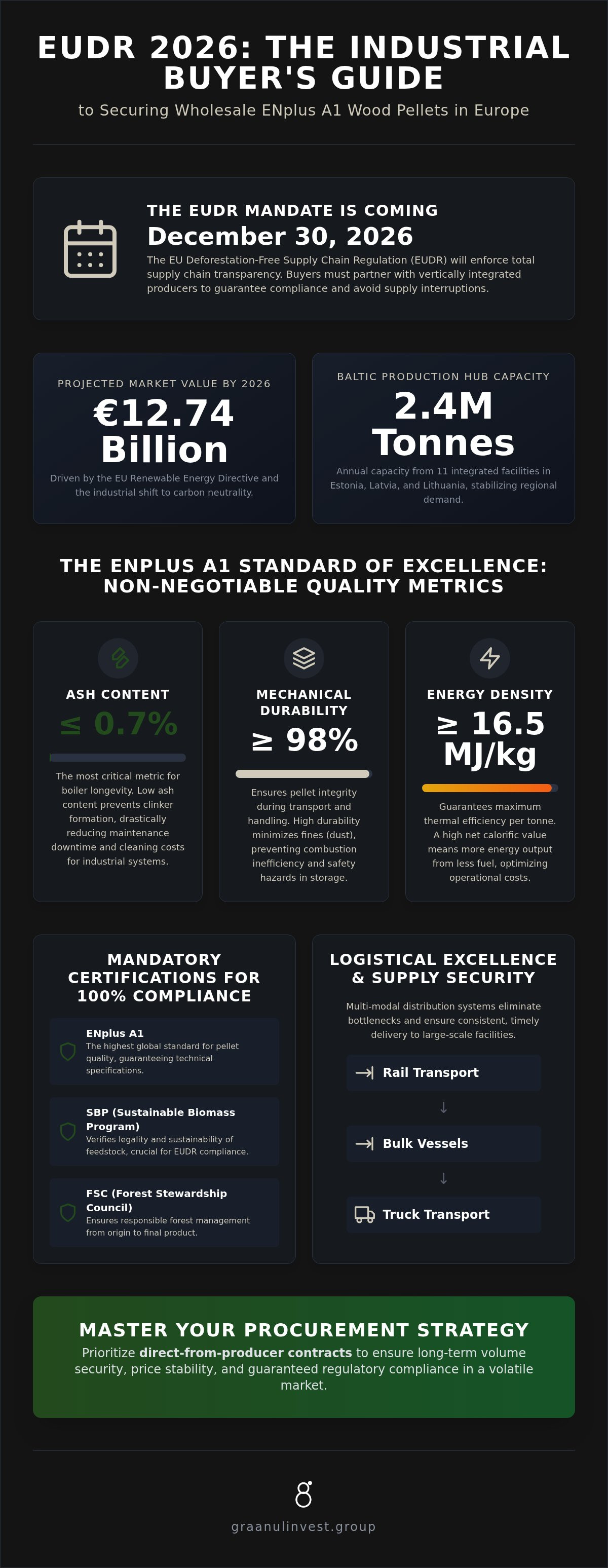
The European bioenergy market has transitioned from a niche alternative to a critical pillar of industrial infrastructure. By 2026, the European wood pellet market is projected to reach €12.74 billion. This growth is driven by the EU Renewable Energy Directive and a collective shift toward carbon neutrality. For industrial and district heating sectors, Pellet fuel serves as a high-density, reliable energy carrier that replaces fossil fuels without requiring total system overhauls. However, the 2026 landscape is defined by scarcity. The removal of Russian export capacity following regional geopolitical shifts has tightened the market. Procurement specialists now prioritize supply security over unit price, seeking direct partnerships with high-capacity industrial producers rather than retail brokers who lack infrastructure.
The Evolution of European Supply Chains
The Baltic states have emerged as the epicenter of European production. Strategic hubs in Estonia, Latvia, and Lithuania provide the necessary scale to stabilize regional demand. These centers utilize 11 integrated production lines to manage a 2.4 million tonne annual capacity. This scale is vital as the EU Deforestation-Free Supply Chain Regulation (EUDR) takes effect on December 30, 2026. Large-scale operators must now prove their supply is traceable to deforestation-free land. Sourcing wholesale ENplus A1 wood pellets Europe from established producers mitigates the risk of supply chain interruptions during the 2026-2027 heating season, where consumption is expected to increase by 500,000 metric tons.
Why Certification is Non-Negotiable for B2B Buyers
For B2B buyers, certifications are no longer optional. They are mandatory compliance tools. ENplus A1, SBP, and FSC certifications provide a verified audit trail that protects buyers from legal and environmental liabilities. These standards ensure that wholesale ENplus A1 wood pellets Europe meet strict technical specifications, such as ash content below 0.7%. High-capacity producers prioritize these metrics to ensure industrial boiler efficiency and minimize maintenance costs. Securing a long-term contract with a certified producer provides a hedge against market fragmentation. It guarantees that your bioenergy supply meets both technical performance requirements and the rigorous environmental standards demanded by European regulators.
Technical Benchmarks: ENplus A1 Certification and Quality Metrics
The ENplus A1 standard represents the highest tier of technical specifications for the biomass sector. It's the primary benchmark for physical and chemical properties in the European market. When sourcing wholesale ENplus A1 wood pellets Europe, professional buyers must verify compliance with the ENplus® quality certification to ensure operational reliability. This standard governs everything from raw material origin to final delivery conditions, providing a rigorous framework for quality control.
Ash content remains the most critical metric for industrial boiler longevity. The ENplus A1 threshold requires an ash content of ≤ 0.7%. Exceeding this limit leads to accelerated clinker formation and increased maintenance downtime. For large-scale operators, even a 0.1% variance in ash can result in tonnes of additional waste and significant cleaning costs over an annual heating cycle. High-quality pellets ensure that thermal output remains consistent without damaging sensitive combustion components or reducing the lifespan of heat exchangers.
Energy density is measured through net calorific value, which must be at least 16.5 MJ/kg. This ensures maximum thermal efficiency per tonne of fuel. Additionally, mechanical durability must exceed 98% to withstand the stresses of pneumatic discharge and bulk handling. Pellets that fail this benchmark generate excessive fines. High dust percentages not only reduce combustion efficiency but also create health and safety hazards in storage facilities. By maintaining these strict mechanical tolerances, we ensure that the fuel arriving at your facility retains its structural integrity.
The Chemistry of Premium Pellets
Raw material selection directly dictates the chemical profile of the fuel. We prioritize clean sawmill residues to keep nitrogen and chlorine levels within strict limits, preventing corrosion in heat exchangers. Moisture content is held strictly at ≤ 10%. Higher moisture levels force the boiler to expend energy evaporating water rather than generating heat. We also monitor ash melting temperatures to prevent slagging in high-temperature industrial environments. These chemical safeguards are essential for maintaining continuous operation in district heating systems.
SBP vs. ENplus A1: Understanding the Difference
It's vital to distinguish between physical and sustainability certifications. ENplus A1 focuses on the material quality for heat production. The Sustainable Biomass Program (SBP) is a framework designed for large power plants to prove carbon-neutral compliance. Our GI-PL-A1 Premium Wood Pellets integrate both standards. This dual certification ensures that your procurement meets both technical performance needs and EU sustainability mandates. You can review our full technical specifications at graanulinvest.group to align your equipment requirements with our production standards.
Logistical Excellence: Multi-modal Distribution and Supply Security
Managing the movement of 2.4 million tonnes of biomass annually requires a sophisticated logistical network that extends far beyond the production line. For procurement specialists, securing wholesale ENplus A1 wood pellets Europe is only the first step; the second is ensuring that this volume reaches its destination without degradation or delay. We utilize a multi-modal distribution strategy that integrates truck, container, rail, and bulk vessels to provide a resilient supply chain. This diversity in transport modes allows us to bypass regional bottlenecks and maintain consistent delivery schedules regardless of seasonal fluctuations or infrastructure challenges.
International trade requires clear definitions of responsibility. We operate under standard Incoterms, including FCA, FOB, CIF, and DAP frameworks, to align with our partners' specific logistical capabilities. Our central assembly house in the Czech Republic serves as a critical strategic node. By positioning this facility in the heart of Europe, we reduce lead times and optimize distribution for Western and Central European markets. This infrastructure ensures that the high standards established by the ENplus A1 Certification are maintained from the moment the pellets leave the Baltic production lines until they arrive at your facility.
Bulk Vessel and Rail Logistics
Maritime exports from Baltic ports form the backbone of our high-volume distribution. By utilizing bulk vessels, we achieve economies of scale that are impossible through road transport alone. Rail logistics further enhance this efficiency, providing a high-capacity terrestrial alternative that significantly reduces the carbon footprint per tonne of delivered fuel. This optimized logistics chain isn't just about speed; it's about operational reliability. Using rail and sea routes minimizes the risk of road-based delays and ensures that industrial-scale volumes are moved with precision.
Packaging and Palletization Standards
Product integrity is a priority during multi-stage international transit. While many industrial buyers utilize bulk shipping, our infrastructure also supports palletized distribution for specialized wholesale needs. Our Czech assembly house plays a vital role here, ensuring uniform packaging quality and secure palletization. This facility acts as a final quality control gate, protecting the mechanical durability of the pellets during the final mile of delivery. Whether arriving via pneumatic discharge or palletized containers, the fuel remains free from excessive dust and moisture, preserving its technical performance for your combustion systems.
Strategic Procurement: Evaluating Large-Scale Biomass Suppliers
Evaluating a strategic partner for wholesale ENplus A1 wood pellets Europe requires a rigorous technical audit of four operational pillars. Large-scale procurement is no longer about finding the lowest price per tonne; it's about securing a reliable link in your industrial supply chain. Professional buyers must move beyond surface-level quotes to assess a supplier's fundamental infrastructure. A failure at any point in the production or distribution chain can lead to costly boiler downtime and regulatory non-compliance.
We recommend a structured four-step evaluation process for all industrial buyers:
- Verify Production Capacity: Ensure the producer's annual output, such as our 2.4 million tonne capacity, can comfortably absorb your total order requirements during peak demand.
- Audit Certifications: Confirm valid ENplus A1, SBP, and FSC credentials to ensure total compliance with the 2026 EUDR mandates.
- Evaluate Logistical Reach: Analyze the supplier's ability to execute multi-modal transport via rail, bulk vessel, and truck to avoid single-point-of-failure risks.
- Assess ESG Reporting: Demand transparency in carbon footprint data and sustainability reporting to satisfy corporate environmental governance.
Direct Producer vs. Broker: Identifying the Risks
Brokers are inherently more vulnerable to market price shocks and regional supply shortages. Because they don't control the production assets, they cannot guarantee volume during demand peaks. Choosing an integrated producer provides "source-to-ship" transparency. This means the entity that harvests the residual wood is the same one that processes the pellets and manages the export. To verify a supplier’s actual ownership, audit their industrial footprint. A market leader should operate multiple production lines across stable regions like the Baltics to ensure wholesale ENplus A1 wood pellets Europe remain available regardless of local disruptions.
Long-Term Contractual Stability
Building partnerships that withstand seasonal demand fluctuations is critical for district heating and industrial energy. Consistent raw material sourcing in the Baltics provides a stable foundation for these agreements. By entering structured wholesale contracts, buyers can mitigate the price volatility seen in fragmented retail markets. These agreements provide a predictable cost basis and, more importantly, a guaranteed volume allocation when the 2026-2027 heating season begins. Integrated producers offer the security of supply that brokers simply cannot match.
Industrial operators ready to secure their 2026 supply volume can contact our procurement team for a technical consultation on large-scale biomass supply.
Graanul Invest: Your Industrial Partner for Premium Bioenergy
Graanul Invest functions as a primary producer, maintaining a 2.4 million tonne annual capacity across 11 industrial production lines. Our operations in Estonia, Latvia, and Lithuania form the epicenter of the European biomass sector. We don't act as a middleman; we control the entire lifecycle of our wholesale ENplus A1 wood pellets Europe. This vertical integration ensures that every batch of GI-PL-A1 Premium Wood Pellets meets rigorous technical specifications, including an ash content of ≤ 0.7% and mechanical durability exceeding 98%.
Our commitment to the circular economy involves utilizing residual and leftover wood from sawmills and forestry operations. By converting these materials into high-density energy carriers, we support the transition toward carbon neutrality. We hold ENplus A1, SBP, FSC, and PEFC certifications, providing a transparent audit trail for all industrial partners. This adherence to international protocols guarantees that your procurement strategy aligns with the 2026 EUDR requirements.
The Baltic Production Advantage
The concentration of our production assets in the Baltics provides a logistical and material edge. We've spent over 20 years refining our pelletizing technology to ensure superior product density and combustion efficiency. Our state-of-the-art facilities produce GI-PL-A1 pellets that are uniform in size and chemical composition. This consistency is vital for industrial clients who require predictable performance in automated heating systems. We prioritize security of supply, leveraging our massive scale to protect partners from the volatility inherent in smaller, fragmented production models.
Global Export Capabilities
Our distribution network is designed for industrial-scale reliability. We utilize bulk vessels, rail, and containers to serve clients across Europe and international markets. The central assembly house in the Czech Republic acts as a strategic hub, optimizing the final stages of distribution for Central and Western European regions. This infrastructure allows us to help industrial clients meet strict carbon reduction targets through efficient, high-volume bioenergy supply. We provide the stability required for long-term energy planning and regulatory compliance.
Professional procurement officers can Contact Graanul Invest for wholesale inquiries to discuss volume allocations and contract terms for the upcoming heating season.
Securing Industrial Energy Resilience for 2026
The 2026 biomass market requires a shift from transactional purchasing to strategic infrastructure partnerships. Professional buyers must prioritize technical precision, such as ash content below 0.7%, and total regulatory compliance to navigate the upcoming EUDR mandates. Securing wholesale ENplus A1 wood pellets Europe from a vertically integrated producer eliminates the volatility associated with brokers and ensures long-term volume stability.
As a direct producer with 11 industrial production lines across the Baltics, we provide the scale necessary for large-scale operations. Our 2.4 million tonne annual capacity is backed by SBP, ENplus A1, FSC, and PEFC certifications, ensuring that every delivery meets international standards for quality and sustainability. We maintain a robust multi-modal distribution network to ensure your facility remains operational throughout the heating season.
By choosing a partner that values precision and logistical excellence, you can focus on your core operations while we handle the complexities of your energy supply. Partner with Graanul Invest for high-capacity bioenergy supply to secure your facility's future. We look forward to building a stable and efficient energy partnership with you.
Frequently Asked Questions
What is the current wholesale price per tonne for ENplus A1 pellets?
Wholesale pricing for wholesale ENplus A1 wood pellets Europe is subject to global market fluctuations and specific contract terms. We structure our pricing based on volume, delivery frequency, and chosen Incoterms like FCA, FOB, CIF, or DAP. Industrial buyers typically secure fixed-price agreements for the heating season to mitigate market volatility. For current rates tailored to your specific volume and logistical requirements, please contact our procurement team directly to receive a formal quote.
How does ENplus A1 certification impact industrial boiler efficiency?
The ENplus A1 standard ensures a consistent ash content of ≤ 0.7% and a net calorific value of at least 16.5 MJ/kg. These technical benchmarks prevent clinker formation and reduce the frequency of maintenance cycles for industrial boilers. High mechanical durability above 98% also minimizes dust accumulation in the combustion chamber. This precision ensures maximum thermal output and extends the operational lifespan of your high-capacity heating infrastructure while reducing downtime.
Can Graanul Invest supply wood pellets via bulk vessel?
Yes, we utilize a sophisticated distribution network that includes bulk vessel shipping for large-scale maritime exports. Our logistical infrastructure supports multi-modal transport via truck, container, rail, and bulk vessels from our Baltic production hubs. This capability allows us to move significant portions of our 2.4 million tonne annual capacity efficiently to international markets. We manage complex maritime logistics to ensure timely delivery to major European ports for all wholesale contracts.
What is the difference between industrial pellets and ENplus A1 pellets?
The primary distinction lies in the technical specifications and intended application. GI-PL-A1 Premium Wood Pellets meet the highest quality standards for residential and light-commercial boilers, emphasizing low ash and high durability. GI-PL-IND Industrial Pellets are designed for large-scale power generation and district heating plants. These industrial-grade products may have higher ash tolerances but provide the massive volume required for continuous, high-output energy production in specialized large-scale facilities.
How do SBP certifications ensure compliance for European power plants?
The Sustainable Biomass Program (SBP) provides a verified framework to demonstrate that woody biomass is sourced legally and sustainably. For European power plants, this certification is essential for meeting carbon-neutral mandates and qualifying for renewable energy subsidies. It ensures that the supply chain is traceable and adheres to strict environmental standards. We integrate SBP compliance across our 11 production lines to support our partners' ESG reporting requirements and ensure long-term regulatory approval.
What are the logistical benefits of sourcing from the Baltic region?
Sourcing wholesale ENplus A1 wood pellets Europe from the Baltics places your supply at the epicenter of European production. The region offers direct access to high-quality raw materials and established maritime infrastructure. Our 11 production lines in Estonia, Latvia, and Lithuania provide a secure supply base that is less susceptible to the logistical bottlenecks found in non-European markets. This proximity reduces transit times and the overall carbon footprint of your fuel supply chain.
Does Graanul Invest provide SBP-compliant biomass for large-scale energy production?
We provide fully SBP-compliant biomass across our entire product range, including GI-PL-IND Industrial Pellets. Our status as a direct producer allows us to maintain total source-to-ship transparency, which is critical for large-scale energy producers. This compliance ensures that your facility meets all EU sustainability directives. By holding SBP, FSC, and PEFC certifications, we guarantee that our 2.4 million tonne annual capacity supports your long-term environmental and operational goals effectively.
What is the minimum order quantity for wholesale wood pellet export?
Our wholesale operations are structured for bulk and palletized distribution to industrial and commercial partners. Minimum order quantities typically start at full truckload (FTL) or full container load (FCL) levels to ensure logistical efficiency. For bulk vessel shipments, quantities are determined by vessel capacity and specific contract requirements. We don't provide residential direct-to-door delivery. Our focus remains on supplying large-scale volumes to distributors, power plants, and district heating providers across Europe.


