

Moving millions of tonnes of biomass across global trade routes is not merely a matter of securing vessel capacity; it's a high-stakes exercise in maintaining material specification under extreme conditions. In the specialized field of wood pellet bulk shipping, the transition from a Baltic production facility to an industrial port in the United Kingdom or Asia involves complex multi-modal handovers where moisture and friction can quickly compromise ENplus A1 standards. You recognize that even minor logistical oversights lead to excessive fines, rejected loads, and significant financial loss.
This guide provides the operational framework required to master these complexities, ensuring your industrial supply chain remains resilient against market volatility and physical degradation. We will analyze the multi-modal journey from factory to silo, identifying cost-effective Incoterms for large-scale biomass procurement. You'll gain a technical understanding of the protocols necessary to preserve material integrity during maritime transit, port handling, and final storage. From managing 2.4 million tonnes of annual capacity to navigating the stricter traceability requirements of the EU Deforestation Regulation, this article outlines the precision required for global biomass distribution.
Key Takeaways
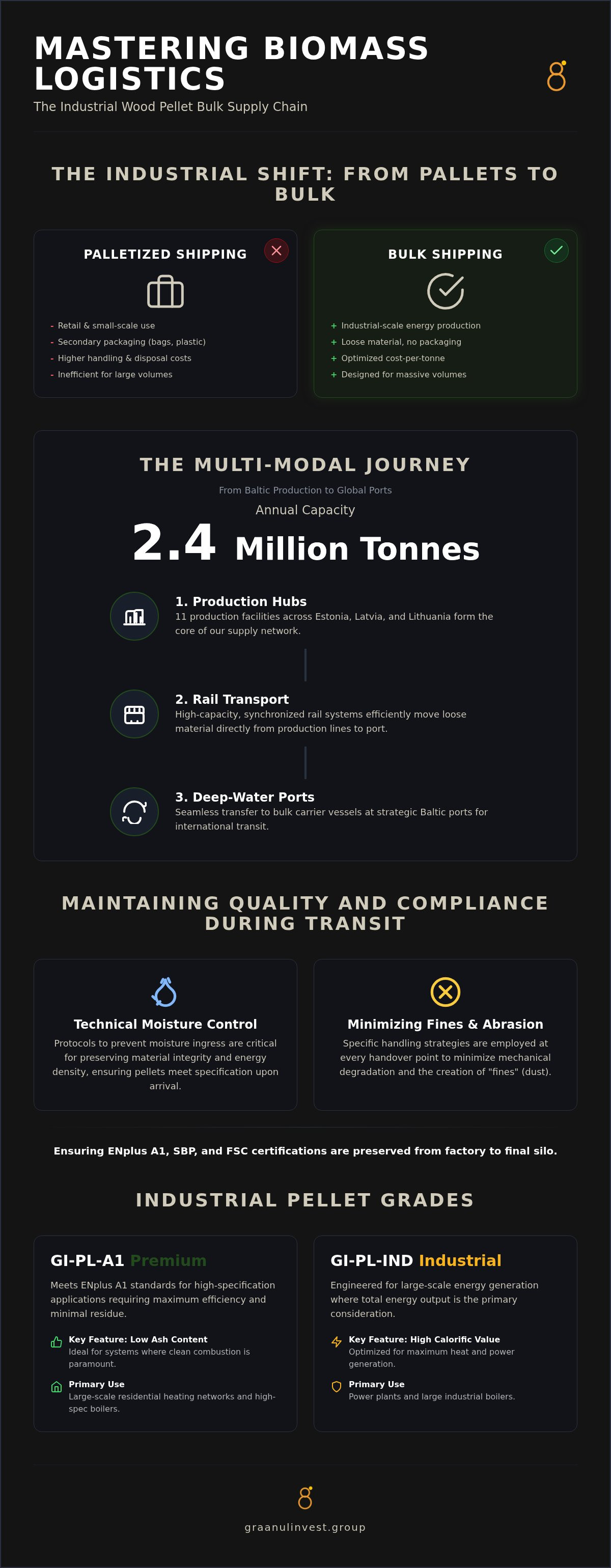
- Industrial wood pellet bulk shipping necessitates a transition from palletized logistics to large-scale, loose material handling via rail and maritime vessels.
- Multi-modal logistics rely on synchronized rail transport from Baltic production lines to deep-water ports to maintain supply chain velocity.
- Material integrity is preserved through technical moisture control and specific handling strategies designed to minimize "fines" and mechanical abrasion during transit.
- Selecting optimal Incoterms like FOB or FCA defines risk transfer and manages the complex logistical costs associated with international biomass trade.
- A Baltic-based production infrastructure with a 2.4 million tonne annual capacity ensures high-volume availability and long-term energy security for industrial partners.
What is Wood Pellet Bulk Shipping in an Industrial Context?
Industrial wood pellet bulk shipping refers to the transport of loose wood pellets in massive quantities without the use of secondary packaging such as bags or pallets. This method serves as the primary logistical pathway for large-scale energy producers and industrial heat consumers. Unlike the retail sector, which relies on 15kg bags or 1000kg big bags, industrial operations require the continuous flow of uncontained material. It's essential for managing the output from massive production hubs, such as our 11 production lines in the Baltics that generate 2.4 million tonnes annually.
The transition to true bulk shipping is driven by economic necessity. By eliminating plastic packaging and secondary handling, operators significantly reduce the price per tonne. Wood pellet bulk shipping optimizes the entire supply chain, from rail transport to deep-water maritime vessels. It allows for a higher volume of material to be moved per shipment, which is critical when serving markets like the United Kingdom, which imports approximately 7 to 8 million metric tons annually. This scale of operation demands rigorous precision to maintain material specifications from the factory gate to the industrial silo.
The Advantages of Bulk vs. Palletized Shipping
Moving biomass in bulk offers distinct operational benefits for large-scale facilities:
- Waste Reduction: Bulk handling eliminates the need for plastic wrap and wooden pallets, reducing the environmental footprint and disposal costs at the destination.
- Storage Density: Loose pellets are pneumatically or mechanically conveyed into industrial silos, maximizing the use of vertical storage space compared to palletized stacks.
- Labor Efficiency: Automated unloading systems for bulk vessels and rail cars require fewer man-hours than manual pallet handling.
- Vessel Optimization: Bulk carriers provide superior cost-per-tonne ratios compared to containerized shipping for high-volume contracts.
Key Industrial Pellet Grades: GI-PL-A1 and GI-PL-IND
The choice of shipping method must align with the specific material grade and end-user requirements. We categorize our offerings into two primary industrial streams:
- GI-PL-A1 Premium Wood Pellets: These pellets meet ENplus A1 standards. They are often shipped in bulk for large-scale residential heating networks or high-specification boilers that require low ash content.
- GI-PL-IND Industrial Pellets: Specifically engineered for power generation and large industrial boilers, these pellets prioritize calorific value and are typically moved in massive maritime volumes.
Maintaining material integrity during bulk transit is paramount. Whether handling GI-PL-A1 or GI-PL-IND, the logistics chain must prevent moisture ingress and mechanical degradation. This ensures the fuel meets international certifications like SBP and FSC upon arrival. Effective bulk logistics don't just move material; they preserve the energy density and chemical properties of the biomass through every handover.
Multi-modal Logistics: From Baltic Production to Global Ports
Efficient wood pellet bulk shipping begins at the production source. Our 11 production lines across Estonia, Latvia, and Lithuania serve as the primary nodes in a vertically integrated supply chain. High-capacity rail systems move material directly from these facilities to deep-water ports. This multi-modal approach ensures we can handle a 2.4 million tonne annual capacity without logistical bottlenecks. While U.S. wood pellet exports represent a significant portion of the global market, the Baltic corridor serves as a critical strategic hub for European and global energy security.
Streamlining the distribution process involves more than just transit. Our central assembly house strategy in the Czech Republic optimizes land-based logistics for Central European markets. This facility acts as a pressure valve, allowing for the rapid deployment of pellets to inland industrial consumers. While maritime routes handle the heaviest volumes, container shipping remains a viable hybrid solution for niche markets or specific volume requirements that don't justify a full bulk carrier. This flexibility allows us to maintain a consistent supply chain regardless of individual port constraints.
Maritime Transport and Bulk Vessel Management
Large-scale maritime exports rely on specific vessel classes. Handysize and Supramax ships are the standard in the pellet trade. They offer the necessary capacity while maintaining the flexibility to enter most industrial ports. Efficient loading requires specialized port infrastructure, including covered conveyor systems and dust suppression technology. We manage the Baltic export corridor to ensure year-round supply, regardless of seasonal weather shifts. This logistical oversight is what maintains the stability of our global distribution network.
Rail and Truck Integration for Inland Distribution
Moving biomass inland requires a different tactical approach. Rail transport provides the highest efficiency for high-volume delivery to major power plants. For the "last mile" or smaller industrial sites, specialized bulk trucks are utilized. These vehicles feature tipping trailers or walking floor systems to facilitate rapid unloading into storage silos. Coordination between rail, sea, and road nodes is designed to minimize material handling. Reducing the number of transfer points is the most effective way to limit mechanical breakage and preserve pellet quality. Those seeking to optimize their own industrial biomass supply chain can leverage this established infrastructure for reliable, large-scale distribution.
Maintaining Quality and Compliance During Bulk Transit
Maintaining material specification throughout the wood pellet bulk shipping process requires rigorous environmental and mechanical controls. Wood pellets are hygroscopic; they readily absorb atmospheric moisture, which compromises their structural integrity and calorific value. Ensuring dry holds in maritime vessels and utilizing covered loading systems at Baltic ports are non-negotiable standards. For long-haul transit, active ventilation and temperature monitoring are essential to prevent self-heating and off-gassing, a known risk in large-scale biomass storage.
Compliance goes beyond physical properties. We maintain a strict data bridge between production and delivery. Every shipment includes comprehensive documentation that tracks sustainability metrics and quality parameters. This ensures that the end-user receives a product that's both physically sound and fully compliant with international regulatory frameworks. This methodical approach to quality control is what differentiates industrial-scale operations from smaller distributors.
Mechanical Handling and Particle Integrity
The primary challenge in bulk logistics is the management of "fines", the small dust particles created by mechanical abrasion. Every transfer point, from rail car to vessel hold, presents a risk of degradation. Industrial conveyor systems and pneumatic blowing must be calibrated to minimize impact velocity. High-quality pellets, such as our GI-PL-A1 premium line, are engineered for high mechanical durability, yet improper loading can still lead to particle segregation.
Best practices for vessel loading involve minimizing the "free-fall" distance of the material. Using telescopic chutes or specialized loading arms prevents the heavier pellets from separating from the fines, which ensures a homogenous mix throughout the hold. This precision ensures that GI-PL-A1 pellets arrive at the destination silo with their ENplus A1 durability ratings intact, ready for efficient combustion in industrial boiler systems.
Sustainability Documentation and Chain of Custody
Maintaining the certification chain-of-custody is as critical as the physical handling of the fuel. As wood pellet bulk shipping involves multiple handlers, we utilize the Sustainable Biomass Program (SBP) framework to track carbon data and forest source information. This digital and physical audit trail ensures that every tonne produced across our 11 Baltic production lines remains verifiable through every handover.
Our integration of FSC and PEFC certifications provides industrial buyers with the assurance of legal and sustainable timber sourcing. This transparency extends from the managed Baltic forests to the international energy producer. By providing detailed sustainability profiles for GI-PL-IND and GI-PL-A1 shipments, we enable our partners to meet their environmental compliance obligations with absolute certainty. The supply chain is not merely a transport route; it's a verified path of stewardship.
Procurement Framework: Navigating Bulk Shipping Incoterms
Procurement strategy for industrial biomass depends heavily on the chosen Incoterms. These international commercial terms define the exact point where costs and risks transfer from the producer to the buyer. In the context of wood pellet bulk shipping, selecting the appropriate framework is essential for managing the multi-modal journey from Baltic production lines to global industrial ports. We offer a range of delivery terms to suit different operational capabilities, ensuring functional clarity and logistical reliability for every contract.
- FCA (Free Carrier): The buyer assumes control at a named place, typically the production facility or a nearby rail terminal. This is suitable for partners with established Baltic logistics networks.
- FOB (Free on Board): This is the industry standard for maritime trade. We manage the material until it's loaded onto the vessel at the port of departure. Risk transfers once the pellets are safely on board.
- CIF (Cost, Insurance, and Freight): We manage the maritime transport and insurance to the buyer's destination port. This simplifies the process for buyers who prefer to manage only the final inland leg.
- DAP (Delivered at Place): This is a full-service solution. We manage the entire supply chain, including sea transit and inland distribution, to the buyer's specified industrial site or silo.
Selecting the Right Incoterm for Your Operation
Risk management is paramount. Choosing between FOB and DAP involves a cost-benefit analysis of internal logistics expertise versus supplier-managed simplicity. If a procurement entity has high-volume shipping contracts, FOB may offer marginal cost savings. However, DAP removes the administrative burden of maritime coordination and ensures a single point of accountability for material integrity. We support various delivery terms to accommodate the specific infrastructure and risk appetite of our global partners. Procurement specialists can view our full range of delivery terms to optimize their industrial supply chain.
Port Logistics and Storage Coordination
Managing time at the port is a critical factor in bulk logistics. Demurrage and dispatch clauses in shipping contracts penalize or reward the speed of loading and unloading. With 11 production lines feeding our export terminals, we prioritize high-speed loading to minimize vessel turnaround time. At the destination port, adequate storage is required to bridge the gap between sea arrival and inland silo delivery. This buffer ensures fuel security for power plants that operate on a continuous combustion cycle. Effective coordination between the vessel arrival and the inland transport fleet prevents bottlenecks and maintains the steady flow of biomass required for industrial operations.
Graanul Invest: A Global Leader in Bulk Biomass Supply
Operational scale is the foundation of energy security in the biomass sector. We operate 11 production lines across Estonia, Latvia, and Lithuania, providing a total annual capacity of 2.4 million tonnes. This infrastructure positions us as a strategic hub for European and global export markets. By maintaining vertical integration from Baltic production to deep-water port assembly, we offer a level of logistical reliability that smaller operators can't match. Our approach to wood pellet bulk shipping is built on precision, ensuring that industrial buyers receive consistent volumes of certified material regardless of market volatility.
The Baltic region serves as an essential corridor for international energy markets. Our proximity to major shipping lanes and integrated rail networks allows for the efficient movement of GI-PL-A1 and GI-PL-IND pellets to global destinations. This geographic advantage, combined with a commitment to environmental stewardship through SBP, FSC, and PEFC certifications, ensures that our partners meet both their energy requirements and their sustainability targets. We prioritize functional clarity in all our logistical operations, moving material with industrial-grade efficiency.
Industrial Scale and Reliability
Supply chain resilience is a critical requirement for power plants and district heating networks. Having 11 production lines ensures that we can maintain a steady output even during periods of peak demand or maintenance cycles. This operational depth is supported by the financial and operational backing of Apollo Global Management, which provides the stability necessary for long-term industrial partnerships. We don't just provide fuel; we provide customized logistics solutions. Whether your facility requires Supramax vessel deliveries or high-frequency rail shipments, our infrastructure is designed to integrate seamlessly with your existing intake systems. This methodical approach to wood pellet bulk shipping minimizes risk and maximizes operational uptime for our clients.
Next Steps for Industrial Procurement
Securing a reliable bioenergy supply requires careful planning and technical alignment. Our team provides comprehensive support for procurement specialists, from initial volume scheduling to destination port logistics. We offer technical consultations to help integrate bulk handling and storage solutions at your facility, ensuring that the transition from vessel to silo preserves material integrity. If you're ready to stabilize your biomass supply chain, you can contact Graanul Invest for industrial bulk pellet supply. Our specialists are available to provide detailed quotes for bulk vessel or rail delivery based on your specific annual requirements and preferred Incoterms.
Optimizing Your Global Biomass Supply Chain
Industrial wood pellet bulk shipping is a precision-driven operation that demands strict adherence to technical standards and logistical protocols. Successful procurement relies on a deep understanding of multi-modal handovers and the strategic selection of Incoterms to manage risk. By prioritizing material integrity through moisture control and dust suppression, you ensure that biomass fuel retains its energy density from the factory gate to the industrial silo.
Graanul Invest provides the infrastructure necessary to support these large-scale energy requirements. With 11 Baltic production lines and a 2.4 million tonne annual capacity, we offer the volume and reliability required for global energy security. Our operations are fully ENplus A1 and SBP Certified, guaranteeing that every shipment meets the highest international standards for quality and sustainability. We invite you to contact our logistics team for a bulk shipping consultation to discuss your specific infrastructure needs. It's the most effective way to secure your long-term bioenergy objectives.
Frequently Asked Questions
What is the maximum volume for a single wood pellet bulk shipping order?
Single shipments typically align with international vessel capacities, often ranging from 15,000 to 50,000 metric tonnes for Supramax carriers. Large-scale industrial contracts frequently involve multiple shipments to meet annual requirements of several hundred thousand tonnes. We utilize our 11 production lines to ensure a continuous supply for these massive volumes. The exact maximum depends on port draft limits and the receiving facility's storage capacity rather than our production constraints.
How do you prevent moisture damage during sea transit of wood pellets?
Preventing moisture ingress requires a combination of technical hold preparation and environmental monitoring. Vessel holds must be certified dry and clean before loading begins. We utilize covered conveyor systems at our Baltic ports to protect the material from precipitation during every transfer. During transit, active ventilation management is required to control humidity levels and prevent condensation. These protocols are essential for maintaining the high calorific value and structural integrity of the pellets.
Which Incoterms are most commonly used for international pellet export?
FOB (Free on Board) and CIF (Cost, Insurance, and Freight) are the most frequent terms for maritime wood pellet bulk shipping. FOB is preferred by buyers with their own chartered vessels, while CIF offers a simplified procurement route for those wanting supplier-managed sea transit. For inland European distribution via rail or truck, FCA and DAP are often utilized. These terms clearly define the risk transfer points between our Baltic facilities and the destination.
How does Graanul Invest maintain SBP certification during multi-modal transport?
We maintain SBP certification through a rigorous chain-of-custody tracking system that documents every handover. This data bridge connects the initial Baltic forest source to the final industrial delivery point. Each multi-modal node, whether rail, port, or vessel, is subject to regular audits to ensure no non-certified material enters the stream. This transparency allows our partners to verify the carbon footprint and sustainability profile of their fuel with absolute precision and regulatory confidence.
What is the difference between bulk vessel shipping and containerized pellets?
Bulk vessel shipping involves loading loose pellets directly into the ship's holds, offering the lowest cost-per-tonne for massive industrial volumes. Containerized shipping serves as a hybrid solution for niche markets or smaller facilities that lack deep-water port access. While containers provide extra protection from handling, they cannot match the logistical efficiency of Supramax vessels. Bulk remains the standard for large-scale power generation and district heating networks requiring tens of thousands of tonnes per shipment.
Can industrial pellets (GI-PL-IND) be shipped alongside premium pellets?
GI-PL-IND and GI-PL-A1 pellets can be shipped on the same vessel if it features multiple segregated holds. Maintaining the distinction between these grades is critical to prevent cross-contamination, especially as GI-PL-A1 has stricter ash and durability requirements. Our logistics team coordinates loading sequences to ensure each grade remains isolated throughout the journey. This allows industrial clients to receive different specifications within a single maritime operation while preserving the certification standards of each product.
How are fines managed during the loading and unloading of bulk vessels?
Managing fines requires minimizing mechanical abrasion at every transfer point in the wood pellet bulk shipping process. We use telescopic chutes and specialized loading arms to reduce the free-fall distance of pellets into the hold. Low-velocity conveyor systems and dust suppression technology at our export terminals further limit particle degradation. During unloading, pneumatic systems or grab cranes must be operated with precision to prevent crushing. These technical strategies ensure the material meets durability specifications upon arrival.
What port facilities are required to receive a bulk shipment of wood pellets?
Receiving a large-scale bulk shipment requires a port with sufficient draft for Supramax or Handysize vessels. The terminal must be equipped with high-capacity unloading systems, such as continuous ship unloaders or specialized grab cranes. On-site covered storage, including silos or flat warehouses, is necessary to protect the material from weather. Finally, the port must have integrated rail or truck links to facilitate the final inland distribution to the power plant or industrial site.


