

Compliance with the EU Renewable Energy Directive (RED III) is no longer a matter of voluntary reporting; it's a fundamental requirement for market access in the global bioenergy sector. Procurement specialists recognize that as regulatory frameworks tighten, the ability to source SBP certified wood pellets becomes the primary safeguard against logistical and legal bottlenecks. You're likely managing the pressure of verifying Greenhouse Gas (GHG) savings while maintaining a steady fuel supply for large-scale operations. It's a complex balance between operational reliability and precise environmental stewardship.
We understand that managing the transition to SBP Standard v2.1 requires more than just a certificate; it demands a deep integration of carbon data and supply chain transparency. This technical guide outlines how SBP certification ensures regulatory compliance and provides the carbon transparency necessary for industrial biomass sourcing. You'll gain a clear understanding of the SBP framework's role in GHG reporting, the impact of RED III alignment, and the logistics of securing high-volume, certified supply from established market leaders with the infrastructure to deliver 2.4 million tonnes annually.
Key Takeaways
- Understand how SBP certification aligns with RED III requirements to ensure continuous regulatory compliance for industrial energy production.
- Learn the technical mechanisms for transmitting accurate energy and carbon data across the supply chain to support precise GHG reporting.
- Discover the synergy between SBP, FSC, and PEFC frameworks in verifying sustainable feedstock sourcing and protecting forest biodiversity.
- Evaluate the logistical requirements for bulk distribution and why a 2.4 million tonne annual capacity is critical for industrial supply security.
- Identify the procurement criteria for SBP certified wood pellets to establish reliable, long-term partnerships with high-capacity producers.
The Strategic Role of SBP Certification in Industrial Bioenergy
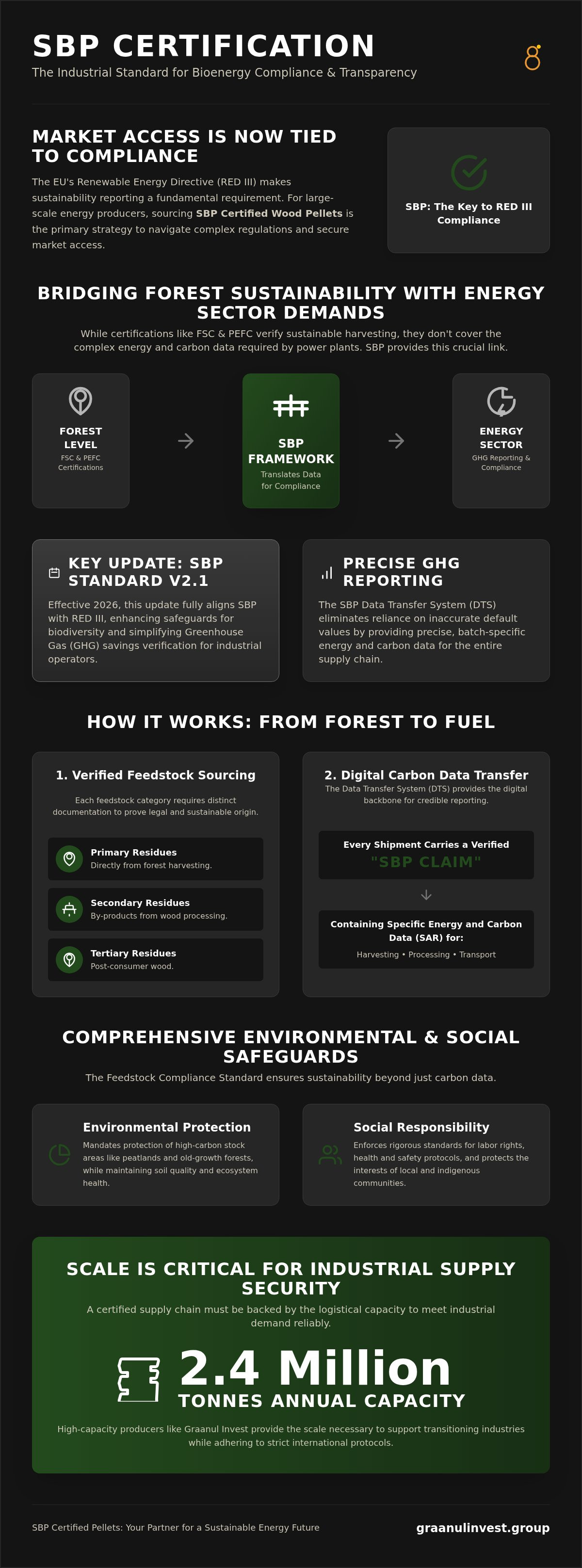
The Sustainable Biomass Program (SBP) is a robust certification framework specifically engineered for woody biomass in the industrial energy sector. It serves as the primary mechanism for verifying that wood pellets meet the legal, environmental, and social requirements of the European energy market. For large-scale energy producers, sourcing SBP certified wood pellets isn't just a preference; it's a strategic requirement for maintaining market access. The program provides the necessary data to demonstrate compliance with the EU Renewable Energy Directive (RED III), which mandates strict sustainability criteria for all biomass fuels.
Bridging the Gap Between Forest and Energy
Traditional forest management certifications, such as FSC and PEFC, are excellent for verifying sustainable harvesting practices at the forest level. They aren't designed to handle the complex energy and carbon reporting required by power plants. SBP acts as a specialized bridge. It translates forest-level sustainability into energy-sector compliance. A central element of this process is the Feedstock Compliance Study. This standard requires producers to evaluate the risk of their sourcing areas against specific indicators, covering everything from soil quality to regional carbon stocks. It ensures that every tonne of fuel delivered is traceable and meets rigorous sustainability benchmarks.
Regulatory Compliance in 2026
As of 2026, the industrial bioenergy landscape is defined by the transition to SBP Standard v2.1. This update aligns the certification with RED III, enhancing safeguards for biodiversity and forest carbon. For procurement specialists in hard-to-abate sectors, this framework simplifies the verification of greenhouse gas (GHG) savings. It provides a modular approach to data collection. This allows for the accurate reporting of emissions from harvesting, processing, and long-distance logistics. By utilizing SBP certified wood pellets, industrial operators can confidently meet national climate targets. Producers like Graanul Invest, with an annual capacity of 2.4 million tonnes, provide the logistical scale necessary to support these transitioning industries while adhering to these strict international protocols.
Technical Standards: Sourcing and Carbon Data Accuracy
SBP standards provide a granular view of the supply chain. This oversight extends from the forest floor to the power plant gate. Verification begins with the classification of feedstock. Primary residues come directly from the forest. Secondary residues are by-products of industrial wood processing. Tertiary residues involve post-consumer wood. Each category requires distinct documentation to prove legal and sustainable origin. As noted in this Biomass explained resource, the diversity of organic materials requires rigorous oversight to ensure carbon neutrality. This categorization is essential for accurate carbon accounting in industrial applications.
The SBP Data Transfer System
The SBP Data Transfer System (DTS) is the digital backbone for industrial carbon reporting. It ensures that every shipment of SBP certified wood pellets carries a verified "SBP Claim." This claim includes specific energy and carbon data (SAR) relevant to the specific batch. End-users receive precise calculations of greenhouse gas (GHG) intensity. This data covers emissions from harvesting, processing, and multi-modal transport. This level of precision is vital for compliance with national carbon accounting frameworks. It eliminates the reliance on default values. Default values often overestimate the carbon footprint of high-efficiency producers. The DTS also prevents double-counting of sustainability claims within the global market.
Feedstock Sustainability Requirements
Beyond carbon data, SBP standards enforce strict environmental safeguards through the Feedstock Compliance Standard. The program monitors land use, land-use change, and forestry (LULUCF) impacts. This ensures that regional carbon stocks are maintained or increased over time. Compliance requires the total protection of high-carbon stock areas, such as peatlands and old-growth forests. Producers must implement measures to maintain soil quality and protect ecosystem health during harvesting operations. Social requirements are equally rigorous. Standard 1 covers labor rights, health and safety protocols, and the interests of local communities. These technical benchmarks ensure that industrial bioenergy supports broader environmental goals. For organizations seeking to secure a compliant supply chain, evaluating the operational standards of large-scale producers is a critical step in the procurement process.
SBP, FSC, and PEFC: Navigating the Certification Landscape
Industrial procurement strategies for biomass require a multi-layered verification approach. While FSC and PEFC are the global benchmarks for sustainable forest management, they don't provide the specific carbon and energy data necessary for power plant compliance. SBP certified wood pellets bridge this gap by utilizing FSC and PEFC as foundational "approved feedstock" sources. This hierarchical structure allows producers to leverage existing sustainable harvesting audits while adding a layer of energy-specific verification. It ensures that the feedstock is both legally harvested and meets the strict GHG intensity targets required by the energy sector.
There is a critical synergy between physical quality standards and sustainability certifications. Industrial buyers frequently specify ENplus A1 quality alongside SBP sustainability requirements to mitigate operational risks. ENplus A1 focuses on technical specifications like ash content, moisture levels, and mechanical durability, which are vital for protecting boiler infrastructure. SBP provides the environmental license to operate under RED III. A supplier that integrates both standards offers a comprehensive solution: high-performance fuel that is fully compliant with international climate regulations. This dual-certification approach is a hallmark of reliable, large-scale operators.
Functional Differences for Procurement
FSC and PEFC focus primarily on the origin of the wood. They ensure biodiversity protection, the maintenance of soil health, and long-term forest productivity. SBP focuses on the lifecycle of the fuel. It tracks the energy consumed during harvesting, processing, and multi-modal transport to calculate a total GHG savings percentage. For a Tier 1 supplier like Graanul Invest, these certifications work in tandem across all 11 production lines. Holding SBP, FSC, and PEFC certifications simultaneously provides a robust risk mitigation profile. It guarantees that every tonne of pellets supports both forest resilience and carbon reduction goals.
The Importance of Chain of Custody (CoC)
Maintaining the integrity of a sustainability claim requires a rigorous Chain of Custody (CoC) system. This protocol ensures that certified material is never mixed with uncertified feedstock during production or storage. Traceability must extend beyond the factory gate to include traders and logistics providers, who are also subject to audit requirements. For bulk vessel shipments, this CoC is vital. It guarantees that the end-user receives a physical fuel batch that accurately reflects the digital data transmitted through the SBP Data Transfer System. This closed-loop verification provides the transparency and operational reliability that industrial partners demand for long-term supply security.
Procurement Criteria for SBP-Certified Biomass at Scale
Industrial procurement specialists must prioritize operational scale to mitigate supply chain volatility. A producer's ability to deliver SBP certified wood pellets consistently depends on their underlying infrastructure and feedstock access. For power plants, the risk of a supply interruption often outweighs marginal price differences. Evaluating a supplier with 11 production lines and a 2.4 million tonne annual capacity provides a necessary buffer against localized harvesting disruptions or logistical bottlenecks. Reliability at this scale is built on the integration of production, storage, and multi-modal distribution systems.
Verifying Certificate Validity
Due diligence begins with the SBP Certificate Directory. This database allows buyers to verify the current status and scope of a supplier’s certification. It is critical to distinguish between "SBP-compliant" feedstock, which meets all sustainability requirements, and "SBP-controlled" feedstock, which meets a lower risk-based threshold. Monitoring public audit reports ensures that the supplier maintains continuous compliance with the latest SBP standards, such as version 2.1. This oversight is vital for maintaining the environmental license to operate within the European market.
Bulk Logistics and Carbon Footprint
The total carbon footprint of biomass is heavily influenced by transport efficiency. Large-scale distribution via bulk vessels and dedicated pellet terminals significantly minimizes the GHG intensity of the final product. Multi-modal logistics, combining rail and sea transport, offer the most reliable and carbon-efficient route for high-volume deliveries. Dedicated infrastructure, such as automated loading systems and deep-water ports, reduces vessel turnaround times and ensures material integrity during transit. For global trade, the proximity of production lines to major shipping hubs is a primary technical advantage that reduces logistical risk.
Contracting for industrial bioenergy requires a focus on long-term supply security rather than short-term spot market fluctuations. Effective strategies incorporate clear definitions of material specifications and carbon data transparency. This ensures the end-user receives accurate GHG saving calculations via the digital Data Transfer System for every shipment. Reliability is established through a supplier's proven track record in multi-modal logistics and their ability to scale production to meet fluctuating seasonal demands. To secure your industrial supply chain with a market leader, contact Graanul Invest for large-scale SBP-certified procurement solutions.
Graanul Invest: A Global Leader in SBP-Certified Production
Graanul Invest maintains its position as the largest wood pellet producer in Europe by prioritizing industrial-scale efficiency and rigorous compliance. The group operates 11 production lines across Estonia, Latvia, and Lithuania. This Baltic footprint provides a unique strategic advantage. It combines proximity to sustainably managed forests with high-capacity maritime export infrastructure. With a total annual capacity of 2.4 million tonnes, the company provides the volume necessary to support the world's largest power plants. This massive scale is essential for maintaining global supply chain stability in an era of increasing energy demand.
Scale and Reliability for Power Plants
Operational reliability in the bioenergy sector depends on a supplier’s ability to absorb localized supply shocks. Graanul Invest’s distributed production model ensures that maintenance cycles or regional harvesting delays don't compromise overall delivery schedules. The company offers specialized product lines tailored for industrial use, including GI-PL-IND Industrial Pellets and GI-PL-A1 Premium Wood Pellets. These specifications are engineered to meet the strict technical requirements of modern boiler systems. As a pioneer in the adoption of SBP standards, the group has developed the internal expertise to customize pellet characteristics for specific industrial applications. This ensures optimal combustion performance and minimal infrastructure wear for end-users.
Logistical excellence is a core component of the group's market leadership. Every production facility is integrated into a multi-modal transport network. This includes dedicated rail links and deep-water port access for bulk vessel shipments. By controlling the logistics chain from the factory to the port, the company reduces the risk of material degradation and ensures the integrity of sustainability claims. This infrastructure allows for the efficient global distribution of SBP certified wood pellets, reaching industrial partners across Europe and Asia with precision and reliability.
Commitment to Transparency and Sustainability
Transparency is a fundamental operational principle for the group. The company published its 2025 sustainability report on July 6, 2026, highlighting significant progress in operational emissions reductions and regulatory readiness. All 11 production lines operate under a unified sustainability framework. This includes the integration of FSC, PEFC, and SBP certifications across all Baltic operations. This multi-layered approach guarantees that every tonne of fuel meets both forest management and energy-specific sustainability criteria. It provides the high-formality documentation required by national regulators and international auditors.
The company manages complex carbon data through the SBP Data Transfer System. This provides global partners with precise greenhouse gas intensity calculations for every shipment. This data-driven approach eliminates the uncertainty associated with biomass procurement. It allows power plants to accurately report their carbon savings under RED III frameworks. For procurement specialists seeking a stable, long-term partnership with an industry leader, contact Graanul Invest for industrial SBP procurement inquiries.
Securing the Future of Industrial Bioenergy Supply
The transition to a low-carbon energy sector requires more than just a shift in fuel; it demands a rigorous framework for sustainability and carbon transparency. SBP certification provides this specialized bridge, translating forest-level management into energy-sector compliance. By integrating SBP with foundational FSC and PEFC standards, procurement specialists can ensure every tonne of biomass meets the stringent requirements of RED III. The digital Data Transfer System ensures GHG intensity calculations are accurate and verifiable, eliminating the operational risks associated with regulatory uncertainty.
Operational reliability at an industrial scale is only possible through established infrastructure and logistical excellence. Graanul Invest provides this stability with a 2.4 million tonne annual capacity across 11 production lines. Holding SBP, ENplus A1, FSC, and PEFC certifications, the group offers a fully verified supply chain supported by global multi-modal logistics expertise. Securing SBP certified wood pellets from a market leader ensures long-term compliance and fuel security. You'll find that a reliable partnership is the most effective safeguard against a changing regulatory landscape. Contact Graanul Invest for SBP-certified industrial pellet supply.
Frequently Asked Questions
What is the primary purpose of SBP certification for wood pellets?
The primary purpose of SBP certification is to provide a comprehensive framework for verifying the sustainability and carbon footprint of woody biomass used in large-scale energy production. It ensures that wood pellets are sourced from legal and sustainable origins while providing precise energy and carbon data for the entire supply chain. This certification allows industrial users to demonstrate compliance with international regulatory standards and verify greenhouse gas savings compared to fossil fuel alternatives.
How does SBP differ from FSC and PEFC certifications?
SBP differs from FSC and PEFC by focusing specifically on the requirements of the energy sector rather than just forest management. While FSC and PEFC certify that forests are managed sustainably, SBP captures the energy and carbon data generated during the harvesting, processing, and distribution of SBP certified wood pellets. SBP leverages FSC and PEFC as "approved feedstock" but adds the technical layers necessary for industrial carbon reporting and regulatory compliance.
Can SBP pellets be used to meet RED III sustainability criteria?
Yes, SBP certification is specifically designed to align with the sustainability criteria of the EU Renewable Energy Directive (RED III). The framework includes rigorous standards for biodiversity protection, soil quality maintenance, and carbon stock preservation. By sourcing certified material, industrial operators can fulfill their legal obligations for reporting greenhouse gas emissions and ensure their biomass usage contributes toward national and international renewable energy targets within the European market.
What is the SBP Data Transfer System (DTS)?
The SBP Data Transfer System (DTS) is the digital backbone used to transmit sustainability claims and carbon data throughout the biomass supply chain. It allows producers to record the specific energy and greenhouse gas (GHG) data associated with each batch of pellets. End-users receive this information through a verified "SBP Claim," ensuring that the carbon intensity of their fuel is documented accurately from the point of production to the point of delivery.
Does SBP certification cover greenhouse gas (GHG) emissions from transport?
SBP certification explicitly covers greenhouse gas (GHG) emissions generated during the multi-modal transport of biomass. The system tracks the energy consumed during every stage of the logistics chain, including rail, road, and bulk vessel shipments. This comprehensive data collection allows procurement specialists to calculate the total carbon footprint of their fuel supply. It ensures that the environmental benefits of biomass aren't negated by inefficient or high-emission transport methods across global trade routes.
How can I verify if a wood pellet supplier is SBP certified?
You can verify the certification status of a wood pellet supplier by consulting the official SBP Certificate Directory. This online database provides real-time information on the validity, scope, and expiration dates of certificates held by producers and traders. It also includes links to public audit reports, allowing procurement specialists to conduct thorough due diligence. For example, Graanul Invest maintains active certification across its 11 production lines, ensuring transparency for its global industrial partners.
What is the difference between SBP-compliant and SBP-controlled feedstock?
SBP-compliant feedstock refers to material that has been fully verified as meeting all SBP sustainability indicators through a supply base evaluation or a recognized forest management scheme. SBP-controlled feedstock is material that has undergone a risk assessment to ensure it doesn't originate from controversial sources but hasn't yet achieved the full "compliant" status. Industrial buyers typically prioritize "SBP-compliant" claims to maximize their verified greenhouse gas savings and ensure the highest level of regulatory alignment.
Why is SBP certification important for industrial power plants?
SBP certification is critical for industrial power plants because it provides the legal and environmental license to operate in regulated markets. It simplifies the complex task of verifying SBP certified wood pellets against national and international climate targets. Without this certification, power plants face significant risks regarding carbon reporting accuracy and regulatory penalties. The framework ensures a reliable, transparent supply chain that supports long-term operational stability and demonstrates a clear commitment to environmental stewardship.


