

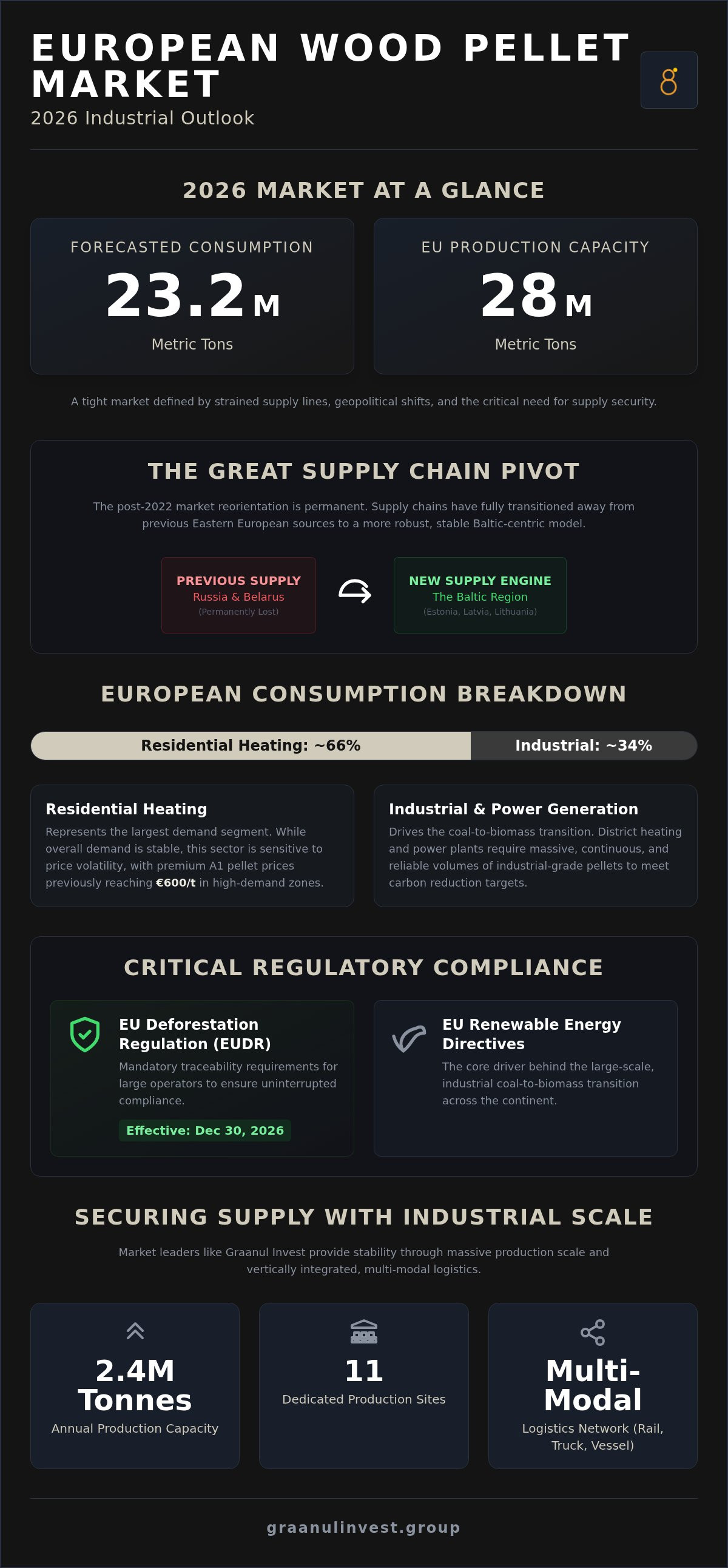
European wood pellet consumption is forecasted to reach 23.2 million metric tons in 2026, yet production capacity remains strained by shifting geopolitical supply lines. Industrial procurement specialists recognize that the wood pellet market Europe has entered a phase of high-stakes volatility. You're likely managing the dual pressures of rising logistics costs and the rigorous traceability requirements of the EU Deforestation Regulation (EUDR), which applies to large operators starting December 30, 2026.
This analysis provides the operational data needed to secure reliable long-term supply contracts and maintain full compliance with evolving EU Renewable Energy Directives. We examine the strategic transition toward Baltic-led supply chains, the industrial impact of 2026 carbon pricing, and the multi-modal logistical innovations required for efficient bulk bioenergy delivery. It's a technical overview designed for professionals who prioritize supply security and industrial-grade efficiency in a tightening global market. Our focus remains on the structural shifts that define the current 28 million metric ton European production capacity.
Key Takeaways
- Identify how the strategic pivot to Baltic production centers provides a stable alternative to previous supply lines in the wood pellet market Europe.
- Understand the mandatory traceability requirements of the EU Deforestation Regulation (EUDR) to ensure uninterrupted compliance for large-scale industrial operations.
- Determine how multi-modal logistical infrastructure, including rail and bulk vessel shipping, mitigates rising transport costs and ensures delivery reliability.
- Analyze the relationship between timber market fluctuations and industrial pellet pricing to optimize procurement strategy and contract timing.
- Evaluate the role of market-leading production scale, supported by 11 dedicated production lines, in securing long-term industrial supply stability.
Current State of the Wood Pellet Market Europe in 2026
The wood pellet market Europe in 2026 is defined by the technical maturity of the coal-to-biomass transition. Major utilities across the continent have largely finalized the infrastructure conversions necessary to replace coal baseloads with high-calorific wood pellets. Total European consumption is forecasted to reach 23.2 million metric tons this year, a steady increase over 2025 levels. Although the total production capacity in the EU is expected to reach 28 million metric tons, regional supply imbalances persist due to localized feedstock constraints. The 2026 market is a balance of industrial scale and strict ecological compliance.
Industrial vs. Residential Consumption Trends
Consumption patterns in 2026 show a clear division between large-scale power generation and the residential heating sector. District heating projects and industrial power plants require massive, continuous volumes of industrial pellets to meet carbon reduction targets. Meanwhile, the heating segment remains the largest consumer, representing nearly two-thirds of total demand. Residential demand in Central Europe shows high stability, though procurement managers now utilize more sophisticated inventory management strategies. These strategies mitigate the risks associated with mild winters and the resulting price volatility in premium A1 markets where retail prices have previously reached €600/t in high-demand zones.
Regional Production Hubs: The Baltic Advantage
The Baltic region's influence on the wood pellet market Europe is underpinned by its role as a critical supply engine. Estonia, Latvia, and Lithuania have secured this position through massive investment in high-capacity production lines and logistical autonomy. Graanul Invest leads this sector with an annual capacity of 2.4 million tonnes across 11 dedicated production sites. This infrastructure is vital for maintaining supply security following the permanent loss of previous Eastern European supply routes.
Technical advancements in wood pellet production allow Baltic producers to maintain rigorous ENplus A1 and industrial specifications at an industrial scale. Recent infrastructure upgrades in Baltic ports support this output through improved multi-modal shipping capabilities. By integrating rail, bulk vessels, and container shipping, these hubs ensure that bioenergy delivery remains resilient against regional logistics disruptions. This specialized infrastructure allows for the rapid movement of bulk volume to Western European industrial hubs, maintaining the operational reliability required by large-scale energy producers.
Supply Chain Dynamics and Logistics Resilience
The post-2022 reorientation of the wood pellet market Europe is now a permanent industrial reality. Supply chains have fully transitioned away from Russian and Belarusian origins, prioritizing long-term stability over short-term cost fluctuations. This shift has elevated the importance of logistical autonomy. Companies that control their own transport infrastructure are better positioned to insulate partners from regional volatility. The permanent loss of previous Eastern European supply lines has necessitated a more robust Baltic-centric model where production and shipping are vertically integrated.
Graanul Invest utilizes a sophisticated multi-modal logistics network to maintain this stability. By integrating rail systems, heavy-duty trucking, and bulk maritime vessels, the group ensures consistent material flow from its 11 production lines. A central assembly house in the Czech Republic serves as a critical inland distribution node. This hub optimizes the movement of GI-PL-A1 and industrial pellets across Central Europe, allowing for efficient rail-to-truck transfers that serve landlocked markets with precision.
Managing Global Trade and Incoterms
Procurement specialists in 2026 must balance risk and control through precise Incoterm selection. While FCA (Free Carrier) offers buyers control over transport, CIF (Cost, Insurance, and Freight) or FOB (Free on Board) at Baltic ports are often preferred for bulk bioenergy shipments. Multi-modal transport strategies are essential here. By transitioning material from rail to bulk vessels, operators significantly reduce lead times compared to standard road-only freight. Risk mitigation in 2026 centers on diversifying port exit points and maintaining real-time tracking across all segments of the journey.
Bulk Export Infrastructure: From Port to Plant
The choice between container shipping and bulk vessels depends on the required volume and the facility's intake capacity. For industrial-scale power generation, bulk vessels are the standard. These vessels handle thousands of tonnes in a single shipment, providing the economy of scale necessary for large utilities. According to the 2026 EU Wood Pellet Consumption Forecast, imports remain a critical component of the market balance, making port efficiency a primary competitive differentiator.
Graanul Invest maintains a robust logistics footprint across Northern Europe, leveraging deep-water ports to facilitate rapid bulk loading. This infrastructure allows for the reliable delivery of GI-PL-IND industrial pellets directly to coastal energy plants. For organizations seeking to secure their 2026 requirements, reviewing the operational capacity of Graanul Invest provides a clear benchmark for supply chain resilience. Industrial scale needs bulk vessels, and our infrastructure is built to support that requirement continuously.
Regulatory Landscape: Sustainability and Certification
The wood pellet market Europe has transitioned into a strictly regulated environment where sustainability credentials are as critical as material specifications. The implementation of the Renewable Energy Directive (RED III) has redefined biomass eligibility by introducing more stringent carbon accounting protocols and primary woody biomass restrictions. Certification is no longer a voluntary market differentiator; it's a mandatory requirement for any operator seeking to qualify for national subsidies or avoid carbon penalties. Procurement specialists must now verify that every metric ton of material aligns with these evolving EU benchmarks.
Technical performance in high-volume boilers depends on the precise management of ash content and calorific value. Higher ash concentrations increase the frequency of maintenance cycles and reduce overall thermal efficiency. Industrial-grade boilers require consistent material density to maintain stable combustion temperatures. SBP certification ensures compliance for industrial energy producers by providing a framework for verifying woody biomass against rigorous carbon and land-use criteria.
SBP vs. ENplus A1: Which Standards Apply?
Standardization in 2026 follows two distinct paths based on the end-use application. Industrial pellets typically adhere to Sustainable Biomass Program (SBP) standards, which focus heavily on the legality and sustainability of the supply chain for power plants. In contrast, the premium retail market relies on ENplus A1 certification. This standard, based on ISO 17225-2, mandates a maximum ash content of 0.7% and moisture levels below 10% to protect residential heating systems. Both standards require foundational FSC or PEFC certifications to guarantee that timber sourcing in the Baltic region remains free from deforestation, a requirement that becomes even more critical as the EU Deforestation Regulation (EUDR) takes effect for large operators on December 30, 2026.
Compliance as a Competitive Advantage
Graanul Invest maintains a 100% certified supply chain across its 11 production lines, providing a transparent audit trail for international buyers. This commitment to industrial-grade efficiency includes rigorous quality control measures that exceed standard ENplus requirements. The audit process for industrial bioenergy procurement has become increasingly data-heavy, requiring producers to provide granular evidence of material origins and processing energy. By securing material from a market leader with established SBP, FSC, and PEFC protocols, procurement managers future-proof their supply against evolving EU environmental protocols. It's a strategic approach that ensures long-term operational reliability while navigating the complexities of European green energy legislation.
Market Price Drivers and Forecasts for 2026
The economic structure of the wood pellet market Europe in 2026 relies on a complex interplay between sawmill output and industrial energy demand. Raw material availability remains the primary determinant of production costs. Since pellets are secondary products of the timber industry, any contraction in construction or sawmill activity directly impacts the volume of available sawdust and wood chips. Manufacturing processes, specifically the thermal energy required for drying and the mechanical energy for pelletizing, represent significant overhead. The rising cost of carbon through the EU Emissions Trading System (ETS) further incentivizes the switch to biomass, maintaining high baseline demand even during periods of broader economic cooling. This creates a floor for wholesale prices in the Baltic-European corridor, ensuring that bioenergy remains competitive against fossil fuel alternatives.
Raw Material Sourcing and Residue Utilization
Sawmill integration is essential for maintaining a stable supply of feedstock. Graanul Invest utilizes advanced residue optimization techniques to convert wood chips and sawdust into high-calorific fuel. This process mitigates the impact of timber market fluctuations. Forestry management policies across the Baltics also play a critical role. Regulations that prioritize sustainable harvesting levels ensure long-term resource availability but can introduce short-term price adjustments when quotas change. Reliable producers manage these costs through massive operational scale and diversified sourcing. It's this industrial-grade efficiency that allows for the continuous conversion of wood residues into standardized energy products.
Wholesale Pricing Structures: Per Tonne Metrics
Procurement strategies in 2026 favor a mix of long-term contracts and strategic spot market activity. Wholesale pricing varies significantly based on the delivery method. Bulk vessel shipments offer the lowest per-tonne cost for industrial users, while truckload deliveries provide the flexibility needed for smaller commercial hubs. Transparent pricing models are now a prerequisite for large-scale energy partnerships. They allow buyers to hedge against energy market volatility while securing reliable volume. For organizations planning their 2026 energy budget, it's essential to contact Graanul Invest for wholesale pricing specifications. Establishing a direct link with a primary producer eliminates the markups associated with third-party brokers and ensures price clarity for the entire heating season.
Strategic Sourcing: Partnering with Graanul Invest
Graanul Invest operates as the primary infrastructure partner within the wood pellet market Europe. With a total annual capacity of 2.4 million tonnes, the group provides the scale necessary to stabilize regional supply chains. This output is supported by 11 dedicated production lines located across the Baltic region. Each facility adheres to rigorous technical standards, ensuring that large-scale procurement remains predictable and transparent. Our product portfolio includes GI-PL-A1 Premium Wood Pellets for the high-end retail sector and GI-PL-IND Industrial Pellets for utility-scale applications. This specialization allows procurement managers to source material tailored to specific boiler requirements and emission targets while maintaining full compliance with international standards like ENplus A1 and SBP.
Scalability for Industrial Energy Plants
Industrial energy plants require massive, uninterrupted fuel volumes to maintain grid stability and meet carbon reduction quotas. The wood pellet market Europe relies on producers who can maintain rigorous quality control while operating at a massive scale. Graanul Invest manages these high-volume demands through a modular production approach that guarantees consistency in technical specifications across all sites. Whether a contract involves ten thousand or one million tonnes, the calorific value, moisture content, and durability remain uniform. This reliability serves as a cornerstone of European energy security, particularly as coal-to-biomass transitions reach maturity in 2026. By utilizing a centralized assembly house in the Czech Republic, the group can deploy material rapidly across Central Europe, effectively mitigating the risks of localized shortages. Industrial partners benefit from a supply chain built on proven capacity and a 100% certified audit trail.
Logistical Excellence and Global Reach
The Baltic-based production hub offers a strategic advantage for European buyers seeking to minimize transit times and logistical complexity. Graanul Invest manages complex international supply lines through a vertically integrated multi-modal network. This system utilizes rail, specialized trucking, and bulk maritime vessels to ensure efficient delivery from port to plant. Bulk export infrastructure is optimized for rapid loading at deep-water ports, facilitating the efficient movement of industrial pellets to coastal power stations. This logistical autonomy reduces lead times and insulates partners from the volatility of third-party shipping markets. For procurement specialists aiming to optimize their 2026 bioenergy strategy, the next step is to Partner with Graanul Invest. Our infrastructure is designed to serve as a reliable link in the global supply chain, providing the precision and scale required by modern industrial operators.
Securing Operational Continuity in a Mature Bioenergy Market
The wood pellet market Europe has reached a stage of technical and regulatory maturity. Success in this environment requires moving beyond spot-market reliance toward integrated partnerships that offer logistical autonomy and certified transparency. The transition to Baltic-led supply chains ensures that industrial and residential demand can be met despite the permanent loss of previous Eastern European routes. Compliance with RED III and upcoming EUDR standards is now the baseline for operational viability.
As a market leader, Graanul Invest provides the structural reliability required by large-scale energy producers. With a 2.4 million tonne annual capacity and fully certified ENplus A1 and SBP supply chains, we offer the precision needed for complex power generation. Our backing by Apollo Global Management ensures the financial stability and infrastructure investment necessary for long-term partnership. We invite you to secure your industrial biomass supply with Graanul Invest and solidify your energy strategy for 2026 and beyond. It's time to prioritize supply security and industrial-grade efficiency.
Frequently Asked Questions
What is the current state of the wood pellet market in Europe for 2026?
The wood pellet market Europe in 2026 is characterized by a balance between 23.2 million metric tons of consumption and 28 million metric tons of production capacity. Market maturity is driven by the finalization of coal-to-biomass transitions in major utilities. Procurement specialists now focus on securing long-term contracts that guarantee compliance with the EU Deforestation Regulation (EUDR). Industrial scale and ecological standards define the current landscape.
How do ENplus A1 and SBP certifications differ for industrial buyers?
ENplus A1 and SBP certifications serve different market segments. ENplus A1 is a technical standard based on ISO 17225-2, focusing on material specifications like ash content and moisture for residential use. SBP (Sustainable Biomass Program) is a framework for industrial energy producers. It verifies the legal and sustainable origins of woody biomass, ensuring compliance with EU carbon accounting and renewable energy directives for large-scale power plants.
Why are the Baltics considered the hub of European wood pellet production?
The Baltics have emerged as the primary supply engine due to vast timber resources and specialized port infrastructure. Estonia, Latvia, and Lithuania provide a reliable alternative to previous Eastern European supply routes. Producers in this region operate at an industrial scale, utilizing advanced production lines to meet the high volume requirements of Western European utilities. This regional hub ensures supply security through vertical integration and logistical autonomy.
What are the primary logistics methods for bulk wood pellet export?
Bulk wood pellet export relies on a multi-modal logistics framework to ensure delivery reliability. The primary methods include:
- Bulk vessels for industrial-scale coastal delivery.
- Rail transport for efficient inland movement.
- Container shipping for palletized premium loads.
Integrating these methods allows producers to manage complex supply lines and reduce lead times for international buyers. This infrastructure is essential for maintaining consistent material flow across global markets.
How does RED III impact the procurement of industrial biomass?
RED III mandates stricter sustainability criteria and more rigorous carbon accounting for industrial biomass procurement. It restricts the use of certain primary woody biomass and makes certification mandatory for qualifying as renewable energy. These regulations ensure that biomass contributes to genuine carbon reductions. Industrial buyers must now provide transparent audit trails to comply with national subsidies and avoid penalties under the EU Emissions Trading System.
What drives the wholesale price per tonne for wood pellets in 2026?
Wholesale pricing in the wood pellet market Europe is influenced by sawmill residue availability and manufacturing energy costs. Since pellets are secondary products, timber market fluctuations directly impact feedstock pricing. Additionally, the industrial demand floor is set by EU ETS carbon prices, which incentivize biomass over fossil fuels. Large-scale producers manage these variables through long-term contracts and operational efficiencies that provide price clarity for energy partners.
Can wood pellets effectively replace coal in large-scale industrial boilers?
Wood pellets are the most effective drop-in replacement for coal in large-scale boilers. They provide a high-density, standardized fuel source with predictable calorific values. This allows utilities to convert existing coal infrastructure with minimal technical modification. The transition enables power plants to reduce their carbon footprint significantly while maintaining the baseload stability required for national energy grids. It's a proven solution for meeting 2026 emission targets.
What is the production capacity of Graanul Invest for the European market?
Graanul Invest maintains a total annual production capacity of 2.4 million tonnes. This output is generated across 11 dedicated production lines in the Baltic region. The group specializes in both GI-PL-A1 Premium and GI-PL-IND Industrial pellets. This massive scale, combined with a central assembly house in the Czech Republic, ensures that we can meet the high-volume demands of international energy plants and retail distributors consistently.


